
Fixing Your moldy Sourdough Starter
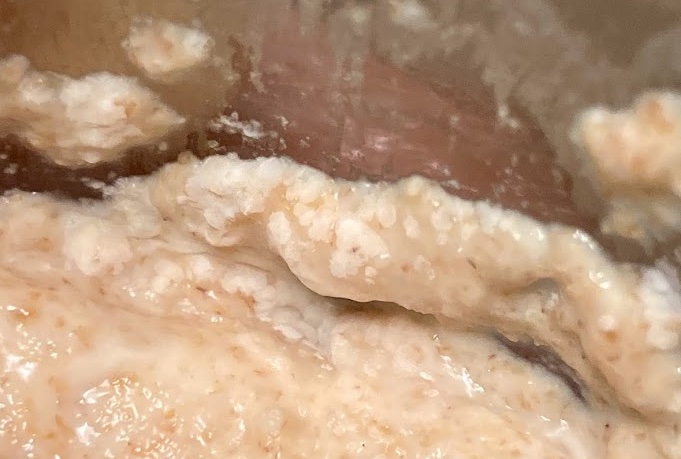
Mold is the worst enemy of your sourdough starter. Many people advise to throw the starter away and create another one from scratch. There might be another way because throwing an old starter away can be quite emotional for bakers.
Update, October 2026: First try the simple fix: take 1 to 2 g from a part of the starter without mold and feed it with flour and water. After a few feedings it should be back to normal. If the mold returns, pickle it as described below, but take the next portion the next day, after shaking the jar: 5 g starter, 20 g flour and 100 g water, for 2 to 3 feedings. Then go back to 100 % hydration. This is the method in my book.
The short version
- Why mold grows: mold needs oxygen, so it grows on top. It can mean that the balance of yeast and bacteria in your starter is off.
- First try: feed 1 to 2 g from a part without mold. After a few feedings it should be back to normal.
- If it comes back: pickle it. Feed a mold-free piece with lots of water, so the flour sits under water without oxygen. Repeat 2 to 3 times.
- Finish sour: acidity keeps mold out, so let the starter sit 24 hours at room temperature before it goes back in the fridge. To be 100 % sure, start a new starter.
Bacteria and yeast should be in a balance
You normally have a balance of fungus (yeast) and bacteria in your starter. If your starter catches mold it might be that something is off in your balance. Often a few feedings from a part of the starter without mold are enough to restore that balance. If the mold keeps coming back, pickle your starter as described below.
Mold likes oxygen
Mold is aerobic and needs to have oxygen. That’s why you will most likely see mold on the top of your sourdough starter. An environment where you have no oxygen will help to prevent mold from growing.
Acidity preserves food
If you look at pickled vegetables or Sauerkraut, acidity is a way to preserve food. The acidity makes sure that no external pathogens can enter this hostile environment. So a very sour sourdough starter will very likely also destroy your mold
The solution
In a previous video I was trying to make a sourdough bread with the help of fruit flies. In between I noticed that there was some mold gathering on top of my starter. Some viewers pointed out it might also have been Kahm yeast. But I wasn’t so sure. So what I did was the following.
- Take a tiny bit of the starter where I see no mold (5g)
- Mix those 5g with another 10g of flour and 50g of water
- After some time you will see that the flour/starter mixture sits near the bottom
- Your starter will be covered in water
- After 2 days try to remove the top liquid part of your starter, take a bit of what’s close to the bottom
- Take 1g for instance, then mix again with 10g of flour and 50g of water
- Repeat another 2 iterations
We are doing 2 hacks here. By letting our starter sit for a longer period of time we are increasing the acidity. Which will be a bad environment for your mold. Furthermore we are create anaerobic (no air) conditions which the mold also does not appreciate at all. By then repeating the process a few times we are slowly killing all remaining mold fungi. You will likely still have a few spores left so that the mold in theory could grow again. That’s why I recommend that you make sure to make your starter quite sour. The more sour the more likely it is that all pathogens other than your sourdough microorganisms are killed. Before it goes back in the fridge, let it sit for 24 hours at room temperature.
Closing words
Please note that I am no doctor and this is not medical advice. If you want to be 100% sure then start a new starter. This has worked for me before, and the science makes sense, but there is no guarantee.