
Sourdough Flowcharts: Make, Feed and Store Your Starter
These flowcharts come straight from my free book The Sourdough Framework. They cover your sourdough starter from the first day to long-term storage.
Every chart is also written out as steps below it. The book explains the reasons behind each step: The Sourdough Framework. It has more flowcharts, from mixing the dough to baking it.
How to make a starter
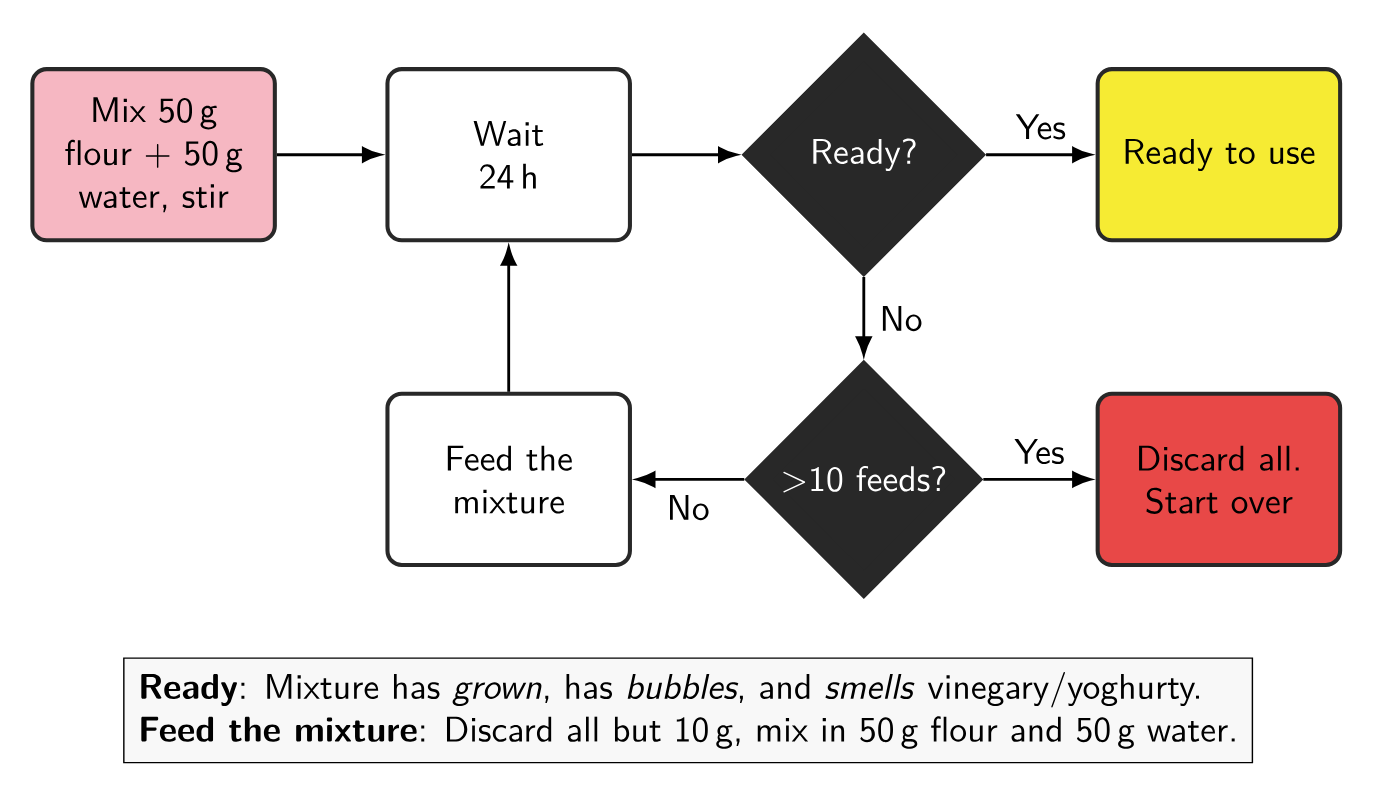
Flowchart 3.1 from my free book The Sourdough Framework: The process of making a sourdough starter from scratch.
- Mix 50 g flour with 50 g water and stir.
- Wait 24 hours.
- Is it ready? It has grown, has bubbles and smells vinegary or like yogurt. Then it is ready to use.
- If not, discard all but 10 g and mix in 50 g flour and 50 g water. Wait another 24 hours and check again.
- Still not ready after 10 feedings? Discard everything and start over.
The full recipe, with the reasons behind each step, is in my sourdough starter recipe.
When is your starter ready?
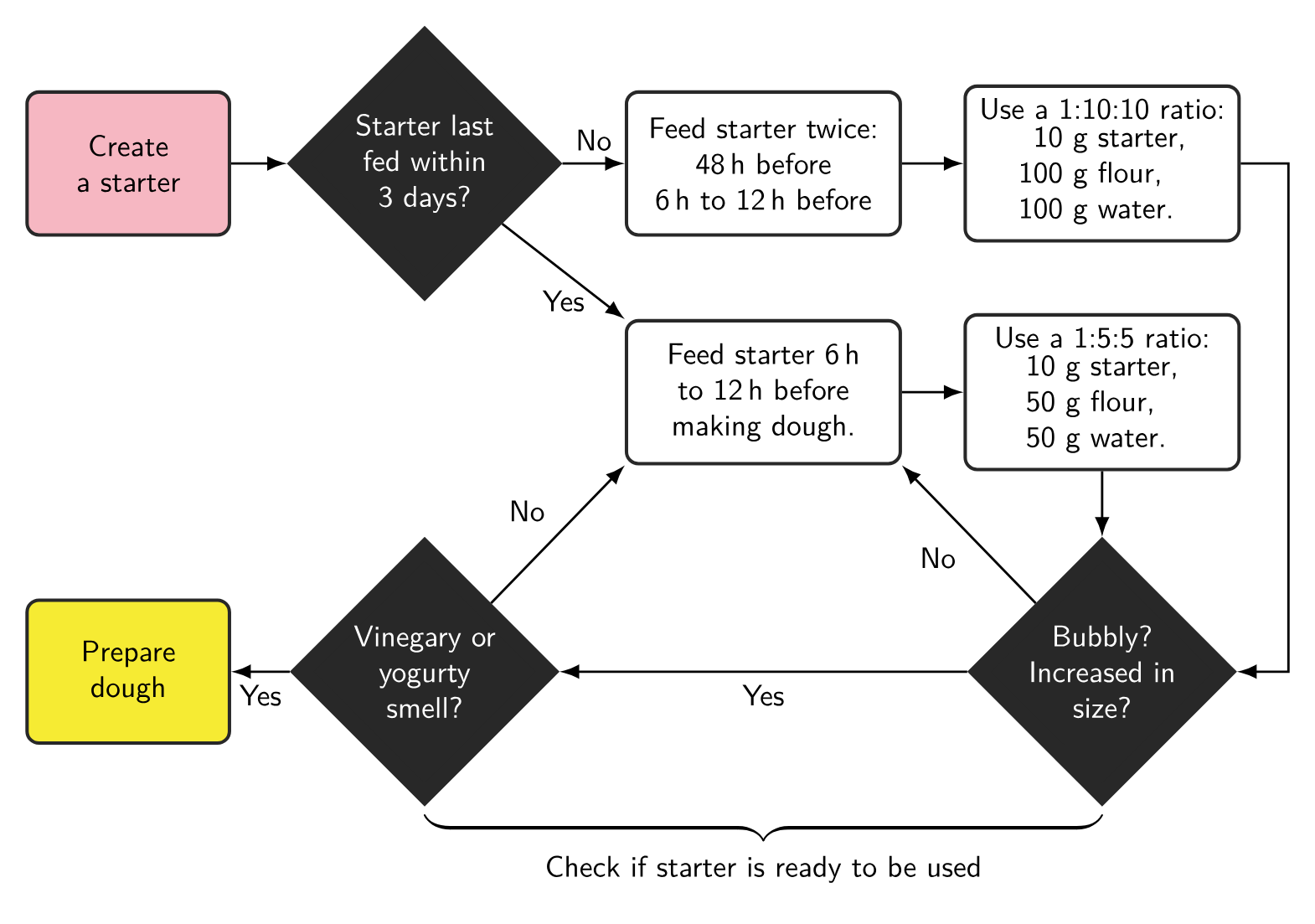
Flowchart 3.2 from my free book The Sourdough Framework: A flow chart showing you how to determine if your sourdough starter is ready to be used. Make sure to wait at least 6 h to 12 h after feeding your starter to check its readiness. To evaluate it, look at your starter's size increase, airy texture and take note of its smell.
- Fed within the last 3 days? Feed it at 1:5:5, 6 to 12 hours before you make your dough: 10 g starter, 50 g flour and 50 g water.
- Not fed for longer? Feed it twice at 1:10:10, 48 hours and 6 to 12 hours before: 10 g starter, 100 g flour and 100 g water.
- Is it bubbly, and has it increased in size? If not, feed it again.
- Does it smell vinegary or like yogurt? If not, feed it again.
- If both are true, prepare your dough.
How much starter to use?
That depends on the temperature and on how recently you fed your starter. This is the table from my book, in percent of the flour weight:
| Temperature | Recently fed | Starving |
|---|---|---|
| 30 °C (86 °F) | 5 % | 2.5 % |
| 25 °C (77 °F) | 10 % | 5 % |
| 20 °C (68 °F) | 15 % | 10 % |
For one loaf with 500 g flour at 25 °C (77 °F) and a freshly fed starter, that is 50 g. My sourdough thermometer covers more temperatures.
How to convert to a stiff starter
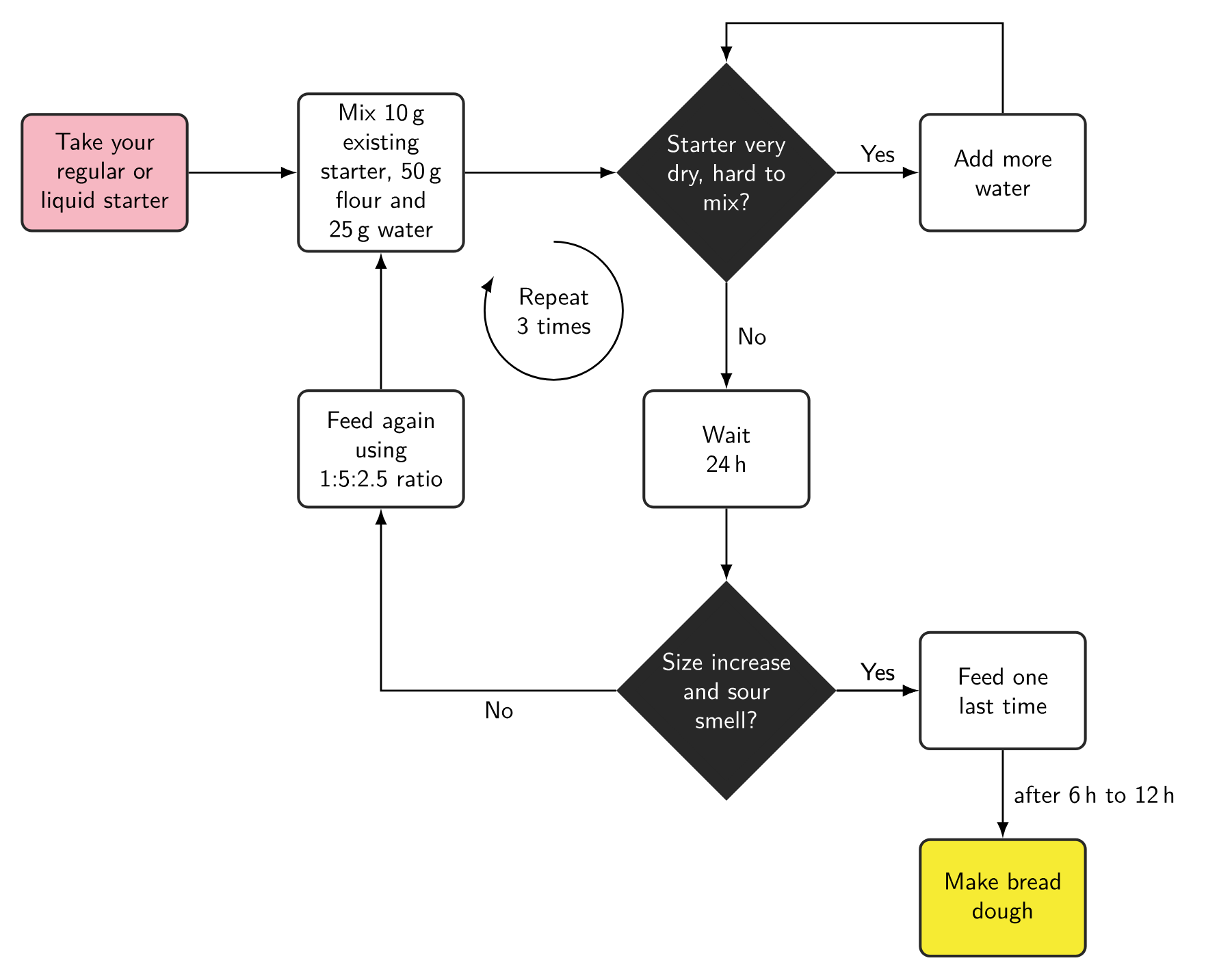
Flowchart 4.2 from my free book The Sourdough Framework: The process to convert your regular starter into a stiff starter. The whole process takes around 3 days. The stiff starter boosts the yeast activity of your sourdough starter. The guide uses a 50 % hydration level; if the dough is too stiff, consider increasing this to 60 %.
- Mix 10 g of your regular or liquid starter with 50 g flour and 25 g water (1:5:2.5).
- Very dry and hard to mix? Add a little more water.
- Wait 24 hours. Has it grown, and does it smell sour? If not, feed it again at 1:5:2.5 and wait another 24 hours. Repeat this up to 3 times.
- Once it has, feed it one last time and make your bread dough 6 to 12 hours later.
More on why a stiff starter is my favorite in regular vs. stiff vs. liquid starter.
How to convert to a liquid starter
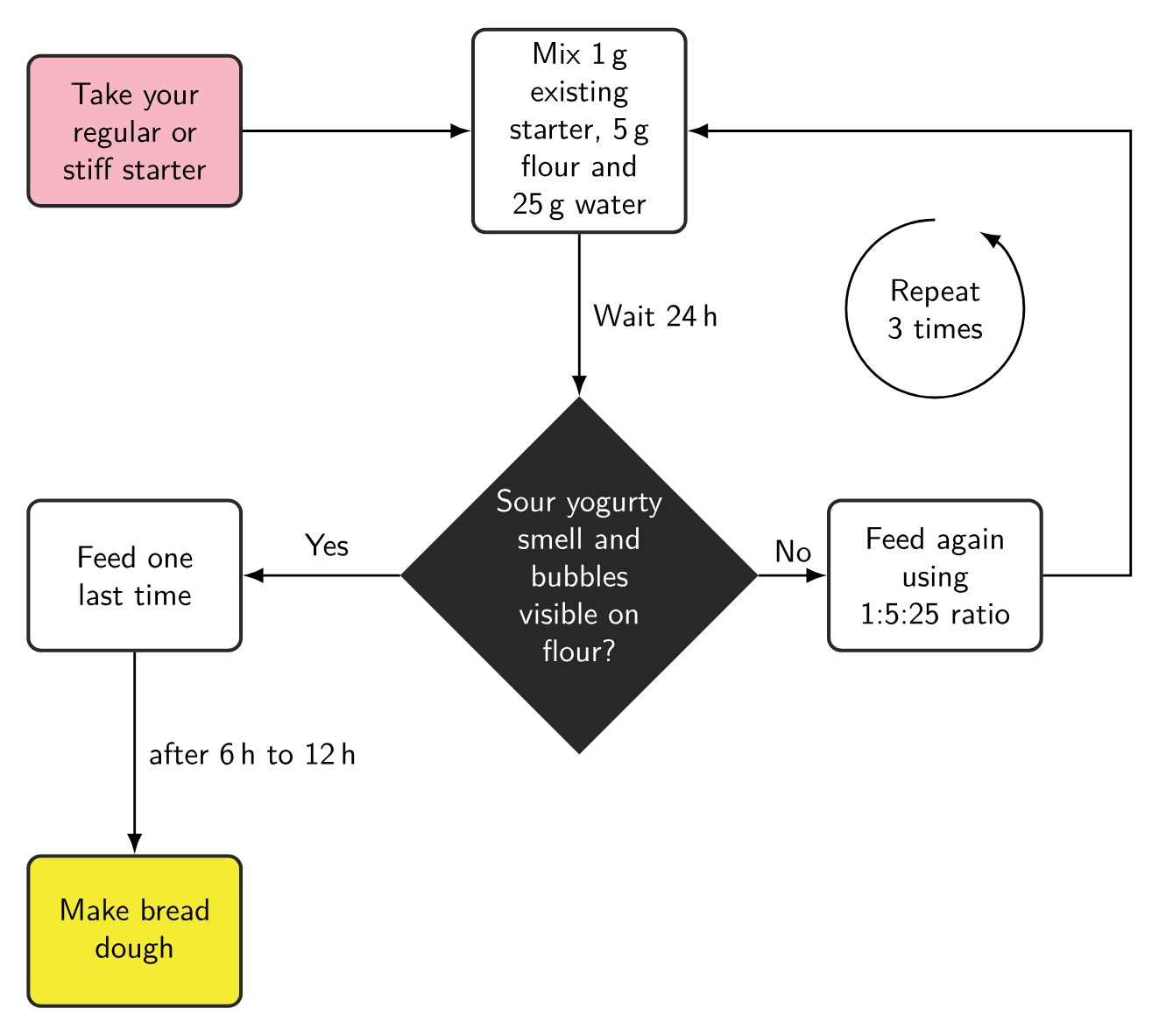
Flowchart 4.1 from my free book The Sourdough Framework: The process to convert your regular or stiff starter into a liquid starter. The whole process takes around 3 days. It is recommended to keep a backup of your original starter, as the liquid environment boosts bacteria that create lactic acid rather than acetic acid.
- Mix 1 g of your regular or stiff starter with 5 g flour and 25 g water (1:5:25).
- Wait 24 hours. Does it smell sour and like yogurt, with bubbles visible on the flour? If not, feed it again at 1:5:25. Repeat this up to 3 times.
- Once it does, feed it one last time and make your bread dough 6 to 12 hours later.
Keep a backup of your original starter first. The liquid environment changes its microbes for good.
Starter maintenance
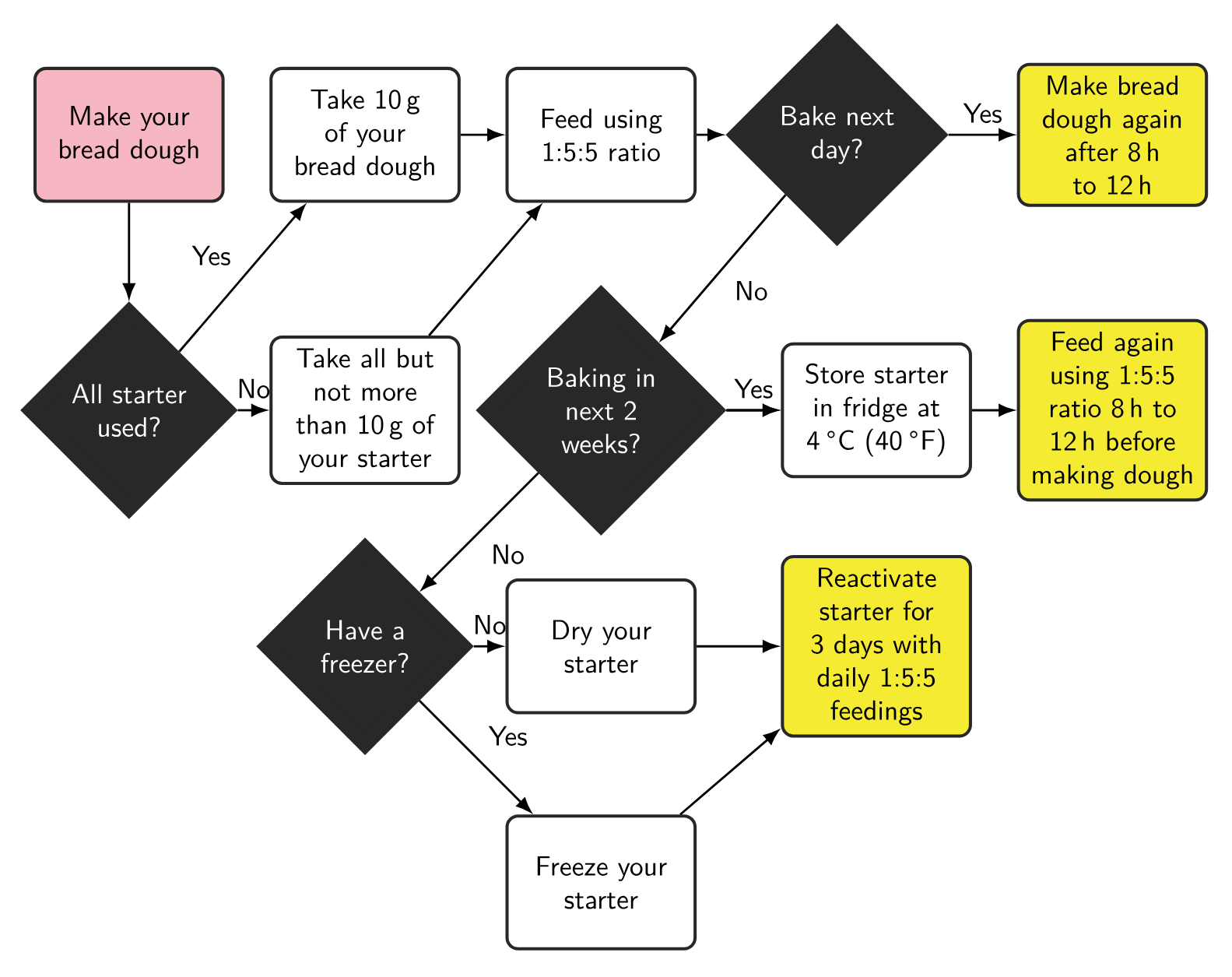
Flowchart 3.3 from my free book The Sourdough Framework: A full flowchart showing you how to conduct proper sourdough starter maintenance. You can use a piece of your dough as the next starter. You can also use left-over starter and feed it again. The chart assumes a starter at 100 % hydration; adjust the water accordingly for a stiff starter.
After you have made your bread dough:
- Used up all your starter? Take 10 g of your bread dough. Otherwise keep no more than 10 g of your starter.
- Feed it at 1:5:5: 10 g starter, 50 g flour and 50 g water.
- Baking again tomorrow? Make your next dough 8 to 12 hours later.
- Baking within the next 2 weeks? Store the starter in the fridge at 4 °C (40 °F). Feed it again at 1:5:5, 8 to 12 hours before you make your dough.
- Longer than 2 weeks? Freeze the starter if you have a freezer, otherwise dry it. To reactivate it, feed it at 1:5:5 once a day for 3 days.
The chart assumes a regular starter at 100 % hydration. For a stiff starter, use half the water. More options in how to store your starter.
Hope you enjoy! Happy baking and may the gluten be with you.